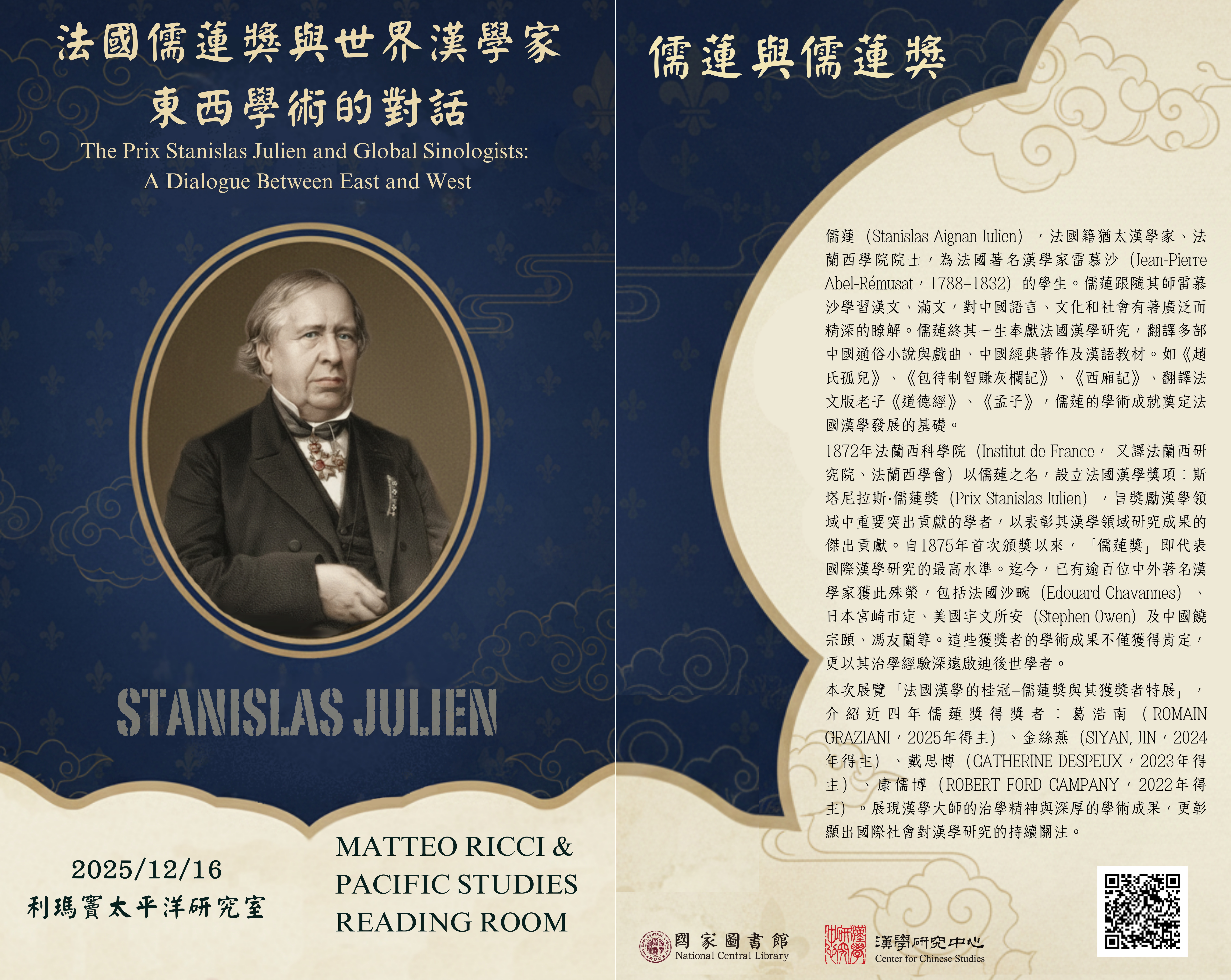
The Prix Stanislas Julien and Global Sinologists: A Dialogue Between East and West
The Prix Stanislas Julien, established in 1872 by the Académie des Inscriptions et Belles-Lettres in Paris and first awarded in 1875, is regarded as one of the most prestigious distinctions in international Sinology. Named after the eminent French scholar Stanislas Julien (1797–1873), the prize honors his mastery of Chinese and Sanskrit and his rigorous philological methods. Julien’s annotated translations of Mencius, the Dao De Jing, The Romance of the Western Chamber, and Tiangong Kaiwu profoundly influenced the transmission of Chinese thought, literature, and technology to Europe.
Often described as the “Nobel Prize of Sinology,” the award recognizes outstanding achievements in linguistics, philosophy, history, literature, religion, and archaeology related to Chinese studies. The first laureate, James Legge, laid the foundation of Western Sinology through his translations of the Confucian classics. In subsequent years, many prominent Chinese scholars were honored, including Feng Youlan, Wang Jingru, Rao Zongyi, Pan Chonggui, and Liao Boyuan, whose works significantly enhanced the global visibility of Chinese scholarship. Other distinguished recipients, such as Swedish archaeologist Johan Gunnar Andersson, Japanese historian Haneda Toru, and American sinologist Stephen underscore the prize’s international scope. The recognition of institutions, notably the Institute of History and Philology at Academia Sinica, further highlights the importance of collective research. The Institute received the award in 1932 for its pioneering contributions to oracle bone studies, the excavation of Anyang, and the systematic preservation and editing of ancient texts—achievements that established new standards in modern Sinology.
The significance of the Stanislas Julien Prize lies in affirming Sinology as a cross-cultural humanistic discipline and promoting global understanding of Chinese civilization. This exhibition presents the 145 laureates to date, with a special focus on the prizewinners of the past four years: Robert Ford Campany (2022), Catherine Despeux (2023), Siyan Jin (2024), and Romain Graziani (2025).
Exhibition Period: Now through June 30, 2026
Opening Hours: 9:00 AM – 5:00 PM
(Closed on Mondays and national holidays)
Venue: Matteo Ricci & Pacific Studies Reading Room(6th Floor, National Central Library)